Grid-down: when the power doesn't come back
There was no warning. The lights are out, the radio is silent, and the outage is not on the utility map. Here is what to do in the first hour, the first day, the first week, and the week after that.
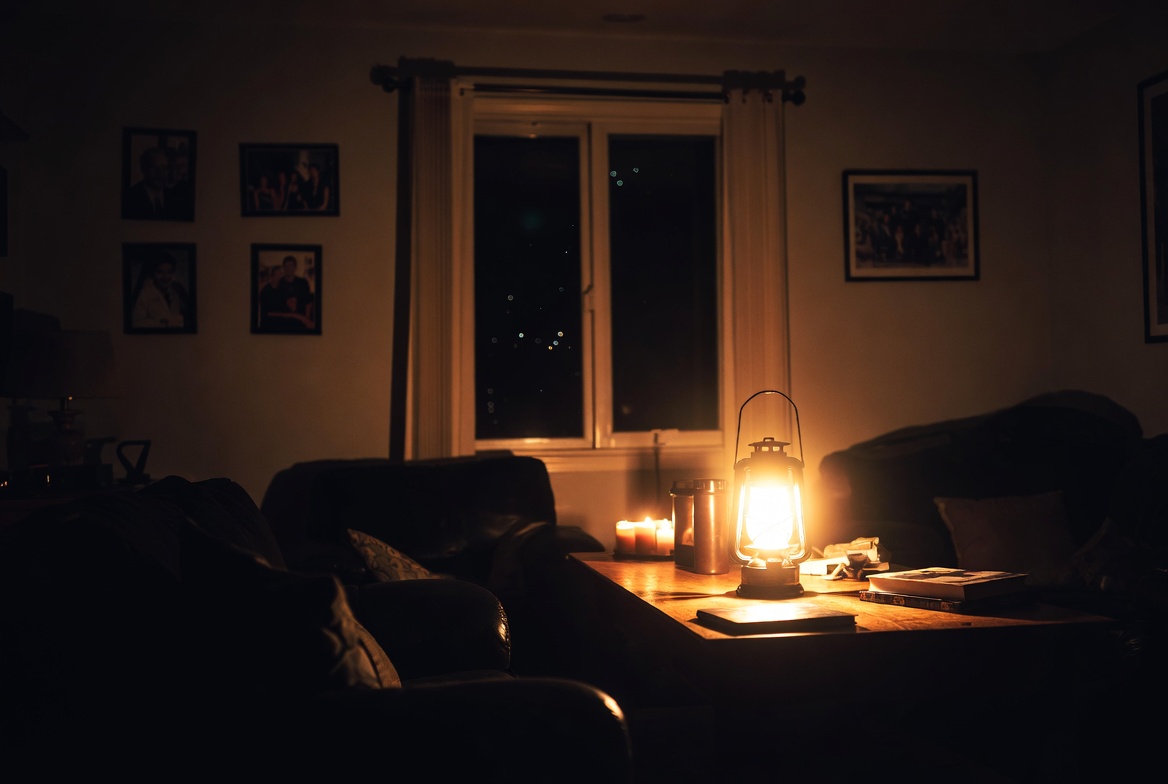
A grid-down event is the playbook with no warning phase. The first hour is diagnostic — is this my house, my block, or the region — because the answer changes everything that follows. Power, water, and security are the three domains that decide whether week two is manageable or dangerous.
First hour — diagnose the scale
- Check the breaker box first. Half the time the 'grid-down' event is a tripped main, a blown service drop on your property, or a single phase out at your transformer.
- Look out the window. Are streetlights on? Are neighbors' houses lit? A dark block with one lit house is your problem. A dark block with no lights is the utility's problem. A dark region with no cell signal is something larger.
- Check your phone. LTE signal but no internet means the towers are running on battery and the backhaul is out. No signal at all means the towers themselves lost power and are likely on a 4–8 hour reserve. Pull the battery-powered AM/FM/NOAA radio out now while you can still hear something.
- Open the utility's outage map on cellular data before the cell towers die. Note the reported extent and the estimated restoration time. Screenshot it — you may not get back online for hours.
- Note the time. Outage logs matter for spoiled-food insurance claims and for tracking how long you've been on your reserves.
- Do not open the fridge or freezer. A closed fridge holds safe temperature for about four hours; a full freezer, about forty-eight. Every opening costs you time.
- If you have a generator, do not start it yet. Wait until you know whether this is a one-hour blip or the start of something longer. Generators burn fuel you cannot replace if pumps are also down.
First 24 hours — establish the new normal
- Consolidate the household into one room. One room with one heat source (winter) or one shaded room with cross-ventilation (summer) uses less of everything — light, batteries, attention.
- Fill every container you have with water from the tap, immediately, while pressure holds. Municipal water systems run on pumps. When the pumps lose power, you have somewhere between two hours and two days of pressure before it drops to zero.
- Eat the perishables first. Anything in the fridge that will spoil in twenty-four hours becomes today's meal. The freezer comes second. Pantry shelf-stable comes last.
- Charge phones and power banks from the car as a last resort. Idle a vehicle outside, never in the garage, with a quality USB adapter. Twenty minutes of idle is roughly one full phone charge.
- If you run a generator, run it outdoors only, at least twenty feet from any window or door, on a level dry surface. Carbon monoxide kills more people in extended outages than anything else. Test the CO alarm in the room where people are sleeping.
- Tell two people outside the affected area what your status is and when you'll check in next. If the outage spreads, they are your wellness check.
- Lock the doors that you don't usually lock. Garage side door, basement walkout, the back gate. Opportunistic risk goes up the longer an outage runs.
First week — the line between outage and emergency
- Switch to gravity-fed water. The bathtub, the rain barrels, the bottled stock. Plan one gallon per person per day for drinking and cooking, plus a separate non-potable supply for flushing and washing.
- Run the generator on a schedule, not continuously. Two hours in the morning to cycle the fridge and freezer back to temperature, two hours in the evening to charge devices. A 5-gallon tank running 8 hours a day lasts about 36 hours; the same tank on a 4-hour-a-day schedule lasts a week.
- Cook outdoors. A propane camp stove or a grill on the patio is safe; the same stove indoors is a CO exposure. Plan meals that use what's thawing fastest.
- Treat unverified water before drinking. A rolling boil for one minute (three at altitude) handles most pathogens. If the water is cloudy, filter through cloth first, then boil. Chemical disinfection — chlorine bleach or iodine — works if you don't have heat.
- Manage waste deliberately. Without water pressure, toilets get one flush from a stored bucket per use. Bag and isolate human waste if sewage lines back up. This is the failure point that turns a long outage into a disease event.
- Check on neighbors who live alone, especially older ones and households with medical equipment. Insulin needs refrigeration. Oxygen concentrators need power. People die from compounding problems, not the outage itself.
- Limit travel. Gas stations need power to pump. Most stations have less than 24 hours of fuel reserve. Every trip you don't take is fuel and time you keep.
Beyond a week — extended grid-down
- Move to ration-level water and food planning. Assume the outage continues until proven otherwise. Calculate days-of-supply on each domain — water, food, medications, fuel — and adjust consumption to whichever is shortest.
- Cash is the only working currency. ATMs are out, card readers are out, and barter is slow and unreliable. The cash you pulled before the outage is the cash you have.
- Communicate on a schedule, not by impulse. Phones on once or twice a day in airplane mode, off the rest of the time. A NOAA radio or shortwave on for the local news bulletin only. Conserve battery aggressively.
- Maintain situational awareness without leaving the house unnecessarily. Walks around the block in daylight, with another household member, in normal clothes, are fine. Long supply runs at dusk in unfamiliar areas are not.
- Document everything. Spoiled food itemized by category, generator fuel logged, medications used. Insurance and FEMA both require records and most households don't keep them.
- Decide your bail-out trigger in advance. At what point do you leave for a relative's house in a different region, a hotel still on grid, or a shelter? Decide before fatigue and stress make the call worse. Write it down.
- Reassess your kit honestly. The fuel that ran out at day six should have lasted to day fourteen. The water that ran out at day three should have lasted seven. Today, while it's fresh, is when you write the after-action.
Grid-down is the event without a forecast. There is no cone of probability, no five-day watch, no warning siren — just a moment when the refrigerator stops humming and the question becomes how big and how long. Every other playbook on this site gives you days to prepare. This one gives you the first hour to figure out what you’re already in.
The diagnostic phase matters more here than anywhere else. A tripped breaker is fifteen minutes of inconvenience. A neighborhood transformer is two to six hours. A regional outage from a storm or a heat-wave-driven brownout is days. A coordinated or cascading failure across multiple states is weeks. The same first ten minutes of work — check the panel, check the block, check the towers, check the map — separates a forgettable evening from the beginning of something that will reshape your month. That diagnostic discipline is the single highest-leverage habit you can build.
This playbook leans hardest on three of the nine domains: power, water, and security. Food matters and shelter matters, but food failures are slow and shelter failures are slower. Power runs out fast, water pressure drops faster than most people expect, and the security domain — locked doors, restrained travel, awareness of who is around your house at night — becomes load-bearing in week two in a way it never is in a one-day outage. The first hour is diagnostic. The first week is logistics. After that, it’s discipline.
The power layer of a multi-day outage has its own arithmetic — what to cycle, what to charge from where, and how to budget a refrigerator on a schedule. The two weeks without grid power guide is the L2 companion to this playbook: same scenario, taken from “what to do in the first hour” to “what your power day actually looks like in week two.”
The grid-down plan at four depths
The playbook above is the event. The links below are the prep system — sized to the depth your household can actually sustain, with checklists, weighted domains, and the questions that come up for each combination.
Get the next playbook before the next storm.
When the next event playbook ships, you get it the day it drops — alongside the 72-hour starter pack PDF today. One new piece every other Sunday.
- The 72-hour starter pack PDF, immediately.
- An email the day the next playbook drops.
- No upsells, no data sold, one-click unsubscribe.