Two weeks without grid power
A 72-hour outage is a logistics problem. Two weeks is an arithmetic problem. Here is what changes — the math, the gear, and the daily rhythm that turns a long blackout into a manageable one.
A 72-hour outage is a logistics problem. You have what you have, you use what you have, help is coming.
Two weeks is an arithmetic problem. The supplies you started with do not last. The phones go dead on day two and the power banks go dead on day three. Whatever your household runs on at hour one is not what it runs on at day eight. The shift from L1 to L2 is the shift from enduring the outage to operating during it — and that requires a different mental model, different gear, and a daily rhythm you have actually practiced.
This guide is the L2 extension of the Power & Light pillar. If you have not read that yet, start there — it lays out the three-leg framework (light, charge, run) that the rest of this builds on.
What changes at two weeks
In the first 72 hours, you can fake almost everything. A phone on airplane mode lasts a day. A headlamp on the bedside table runs for thirty hours on a single AAA set. A fridge full of food stays cold for two days if nobody opens it. The grid-tied life has a brief afterlife on inertia alone.
By day four, that’s all gone. The disposable batteries are running out. The food in the fridge is finished or thrown out. The car you were charging phones from is down a quarter tank and gas stations have no pumps. The decisions you didn’t have to make in the first three days now have to be made every six hours: what stays on, what comes off, what gets charged tonight and what waits until tomorrow.
The household that handles this well is not the one with the biggest generator. It is the one that practiced the rhythm before they needed it.
The three-leg framework, restated for L2
The pillar lays out three layers: light (seeing in the dark), charge (keeping small electronics alive), and run (operating larger loads). At 72 hours, you can solve light and charge with stored batteries and ignore run entirely. At two weeks, each of the three layers needs its own refueling path.
Light at two weeks
Headlamps and flashlights solve seeing in the dark. The thing they do not solve at two weeks is the slow drain — the household burning through 20-pack after 20-pack of AA batteries because every light got left on for too long, in too many rooms, by too many people.
The L2 light setup looks different:
- LED lanterns with rechargeable batteries as the primary household light. They put out enough light for an entire room, last 30–80 hours on a charge, and recharge from the same power station that runs the phones. The disposable headlamps become the secondary system — for going outside, going to the basement, going anywhere a lantern can’t follow.
- One light per room you actually use, not one per room you have. The household consolidates into the kitchen and one bedroom or living space after dark. Powering eight rooms is wasteful; powering two is sustainable.
- A “lights off by 9” rhythm. Solar charges during the day. Lanterns burn at night. If the household lives on the sun’s schedule, the math works. If it lives on the grid-era schedule, it doesn’t.
Charge at two weeks
A 20,000 mAh power bank holds about three phone charges. For a single phone in a 72-hour outage, that is enough. For a household of four with phones, headlamps, a NOAA radio, a tablet for the kids, and a power-bank-for-the-power-bank — it lasts about a day and a half.
At L2, the charge layer needs a source, not just a reserve.
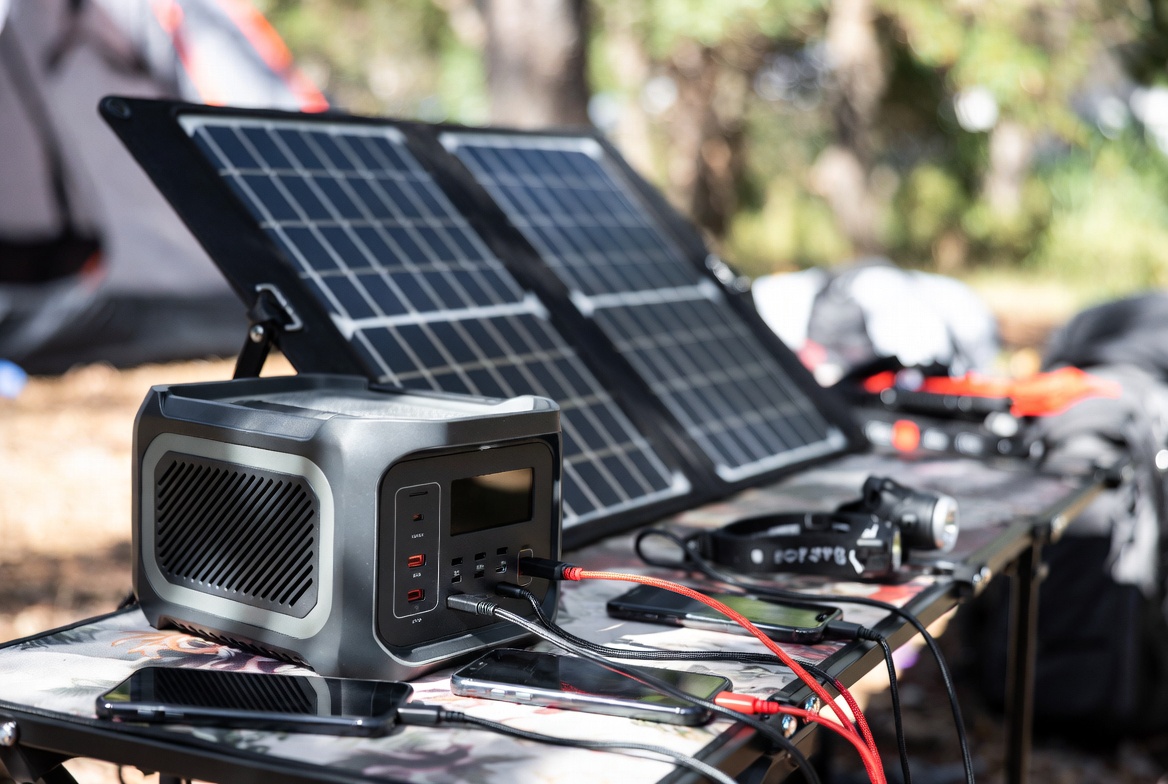
- A portable power station in the 500–1500 watt-hour range becomes the household’s middle layer. Phones, lights, the NOAA radio, and any small medical device (a CPAP, a continuous glucose monitor) all run off it. Brands have proliferated — the spec that matters is total watt-hours, total continuous wattage, and whether it supports solar input.
- A 100–200 watt foldable solar panel is what makes the power station sustainable past the second day. Two hundred watts of solar in full sun produces roughly 800–1200 watt-hours per day — more than enough to fully recharge a 1000 Wh station and run a refrigerator on a schedule.
- A car-to-USB adapter as the backup-to-the-backup. Twenty minutes of idle, two phones charged. Don’t run a vehicle inside a garage even with the door open. Outside, on level ground, windows down — same rules as a generator.
Run at two weeks
Run is the layer that requires real infrastructure, and it is the layer where most households make the largest mistake. The instinct is to buy a 7500-watt gas generator that can run the whole house. The actual L2 power plan runs nothing continuously — it cycles, on a schedule, what matters most.
- Refrigerator and freezer. Two to three hours of cooling every twelve hours holds safe temperature on a small fraction of the power that continuous operation would draw. A 1000 Wh power station with a 200 W solar panel can sustain this indefinitely in any sunny climate.
- A medical device on continuous power if someone in the household requires it. This is the load that must be planned around. If a household member uses a CPAP, an oxygen concentrator, or insulin requiring refrigeration, those are the loads that get priority, and the whole power budget builds around them.
- A generator only if the above demands it. A 2000–3500 watt inverter generator burns about a quarter to half a gallon of fuel per hour at moderate load. Five gallons of stored fuel runs that generator three to four hours a day for a week. Two weeks needs ten gallons stored and rotated, or a dual-fuel model that can switch to propane.
The day-by-day rhythm
This is the part most preparedness writing skips, and it is where most household failures happen. Owning the gear is the cheap part. Running the gear on a schedule, for two weeks, in the dark, with kids and pets and a routine you didn’t choose, is the part you practice.
A working L2 power day looks like this:
Morning. Solar panel out as soon as it is light. Power station on charge. Plug in the lanterns, plug in the phones, plug in anything that ran overnight. Check what’s at what charge level. Make a decision about the fridge run for the morning.
Midday. Fridge cycles for two to three hours during peak solar. Lanterns and phones reach full charge. Power station tops up. Anything else that needs power — a laptop, a fan, a small kitchen appliance — runs during this window.
Late afternoon. Fold up the solar panel before the dew sets in. Bring the power station inside. Last opportunity to top up the day’s reserves.
Evening. Lanterns on for the household’s primary room. Phones go on airplane mode. NOAA radio runs for the local news bulletin only. The household lives on stored power, not solar.
Night. Lights off in unused rooms. Phones charging from the power station overnight if needed. The household sleeps. The fridge does not run.
The single most important habit in this rhythm is the load decision at every transition. What gets power right now, what waits, what stays off. Most households over-run their reserves in the first three days because they cannot make that decision quickly under stress. The households that practice — running a “grid-down weekend” twice a year — make it without thinking.
Common mistakes at two weeks
Treating the generator as continuous backup. A generator is a tool for high loads and short windows, not for running a house twenty-four hours a day. Continuous-run generator outages eat fuel reserves in three days and leave the household with no backup at the moment the gas station also has no power.
Skipping the solar layer. A power station without solar is a battery. A power station with solar is a refueling station. The cost difference is one or two hundred dollars; the operational difference is unlimited.
Buying the wrong battery sizes. Most disposable battery shortages in extended outages are not the headlamps — they are the smoke detectors, the kids’ toys, the door sensors, the keyboard, the smart thermostat. Inventory the AA and AAA load before the outage. Most households are short by a factor of three.
Letting the power station discharge below 20%. Lithium chemistries degrade fast at deep discharge. The household that runs its power station to zero in week one is the household that has half the capacity in week two. Same rule as a phone: charge before it gets desperate.
Storing gas without stabilizer or rotation. Most extended-outage generator failures are fuel failures. Stabilized gasoline rotated annually, or a propane-only system, are the only two reliable answers.
Forgetting the boring loads. Smoke and CO detectors run on batteries that go dead. A fire or CO incident during a two-week outage is a worse problem than the outage. Change those batteries on a schedule, not when they chirp.
Where to go next
The power outage kit gear breakdown lays out the specific equipment at three price tiers — the budget setup that solves 72 hours, the mid-tier setup that extends to two weeks, and the premium setup that handles months. Pair it with this guide and you have both the system (what to do) and the kit (what to buy).
The grid-down playbook covers what to do when an outage has no forecast and no estimated restoration time — the diagnostic phase, the first-week pivot, the bail-out trigger. The winter storm playbook covers the same arithmetic when the outage arrives in the cold, which is where most fatalities happen and where the power layer interacts with the shelter and warmth layer in ways that matter — the two-week heat plan covers that side of the problem: the warm room, the insulation sequence, and the fuel math.
Two weeks without grid power is not a worst case. It is a real case, regular enough that most American households will see one within ten years. The gear list is a one-time purchase. The rhythm is a one-weekend practice. Both of them, done now, are the difference between two weeks of inconvenience and two weeks of emergency.
Questions readers ask.
- How much power does a household actually need for two weeks without the grid?
- Less than most people assume — if you decide what runs and what stays off. A typical household can manage two weeks on roughly 1–2 kilowatt-hours per day if it cycles a refrigerator on a schedule, charges phones and lights from a power station, and skips everything optional. That is well within range of a mid-size portable power station plus a 200-watt solar panel, or a small generator running two to four hours a day on stored fuel.
- Should I buy a generator or a portable power station for a two-week outage?
- Both, if budget allows, but in that order: power station first, generator second. A power station is silent, indoor-safe, refuelable from solar, and handles every load below 1500 watts — which covers light, charge, comms, and a refrigerator running on a schedule. A generator extends that to bigger loads and to scenarios where solar is not an option. Most households over-buy generator capacity and under-buy power station capacity. The math goes the other way.
- How long will a refrigerator stay cold during a multi-day outage?
- A closed fridge holds safe temperature (below 40°F) for about four hours. A full freezer holds for about 48 hours; a half-full one for about 24. After that, the goal is not continuous cooling — it is cycling. Run the fridge for two to three hours every twelve hours and it will hold safe temperature indefinitely on a fraction of the power a continuous run would draw. This is the single biggest leverage point in a two-week power plan.
- Is it safe to store gasoline for a multi-week outage?
- Yes, with stabilizer and rotation. Stabilized gasoline keeps for six to twelve months in a sealed metal or HDPE container, stored cool and out of sunlight. Without stabilizer, gasoline starts degrading at three months and can foul a carburetor by six. Most extended-outage generator failures are not the generator — they are the fuel that sat in it too long. Propane is the alternative: it stores indefinitely without degradation, which is why most long-term prep generators are dual-fuel or propane-only.
- What is the minimum power kit for a two-week outage?
- A 500–1000 watt-hour portable power station, a 100–200 watt foldable solar panel, four LED lanterns, one headlamp per adult, a battery-powered NOAA radio, and 20–40 amp-hours of stored alkaline batteries in the sizes your devices use. That covers light, charge, comms, and small-load cycling for two weeks in most climates. A generator and stored fuel become useful at the next level up — when refrigeration, well pumps, or medical devices enter the picture.
Get the next deep-dive in your inbox.
One new guide every other Sunday. The 72-hour starter pack as a printable PDF arrives the moment you sign up.
- The 72-hour starter pack PDF, immediately.
- A new deep-dive — like this one — every other Sunday.
- No upsells, no data sold, one-click unsubscribe.