Two weeks of water
Fourteen gallons per person is the number, and the number is the easy part. The hard parts are weight, floor space, rotation, and what happens on day nine when the stored water runs out — which is why a real two-week plan is storage plus treatment plus sourcing, not a wall of jugs.
Seventy-two hours of water is a closet problem. Three gallons per person fits behind the winter coats, and the family-of-four guide covers that level — twelve gallons, one shelf, done by the weekend.
Two weeks is a different kind of problem, and it is worth being honest about what kind. The math is trivial: one gallon per person per day, times fourteen. The problem is what the math weighs. A family of four’s two-week supply is 56 gallons — about 470 pounds of water, the better part of a refrigerator, that has to live somewhere, on a floor that can hold it, in containers you can actually lift, rotated on a schedule you will actually keep.
So the real two-week plan is not “store more.” It is the full three-leg system from the Water pillar — store, clean, source — with the center of gravity starting to shift from the first leg to the other two. This guide is the L2 implementation.
The target, honestly
Start with the floor: 14 gallons per person. Then adjust it for your household instead of pretending the average is you:
- Heat and exertion push drinking needs up 50–100%. A Kentucky August without air conditioning is not a one-gallon-a-day situation.
- Pets count. A dog is roughly a quarter to half a gallon a day depending on size; cats less. Add it to the total rather than discovering the math on day six.
- Illness is the multiplier nobody plans for. Rehydrating one sick family member can consume a healthy person’s full daily ration on top of their own. The two-week scenarios — the grid-down event, the boil-water advisory that follows a flood — are exactly the scenarios where someone gets sick.
For a family of four, call it 56 gallons as the floor and 70 as the honest number. Now — deliberately — don’t store all of it. Store seven to ten days comfortably and close the rest with treatment and sourcing. The all-storage version of the two-week plan is the version that fails inspection: it bows the shelf, blocks the hallway, never gets rotated, and is still finite on day fifteen.
Leg one: storage that actually works
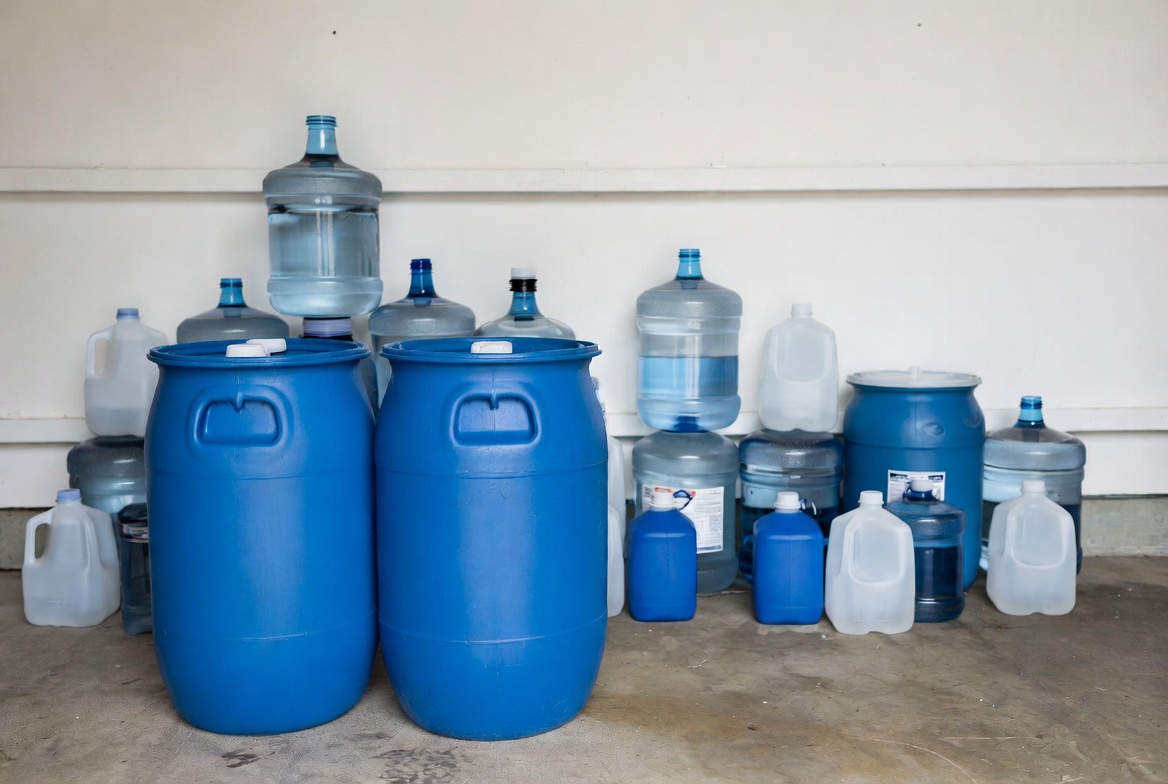
Containers. The workhorse at this level is the 5–7 gallon stackable water container — rigid HDPE, food-grade, with a spigot. Big enough that you aren’t managing forty jugs, small enough that one adult can carry it (a 7-gallon container is 58 pounds). Two or three 5-gallon containers per person, plus a case or two of retail bottled water for grab-and-go and for handing to a neighbor, covers the storage leg for most households.
The 55-gallon drum is a fine tool with two honest costs: it commits 460 pounds to one spot on a concrete slab forever, and it requires a pump and a bung wrench to get water out. Buy it when you have the slab and the discipline, not as the first move.
And the containers to refuse: milk jugs (not food-grade, seams fail in months) and anything that previously held anything but water or food.
Placement. Ground floor or basement slab, cool, dark, off bare concrete (a scrap of plywood prevents temperature cycling and plastic-to-concrete contact), away from gasoline, solvents, and anything that off-gasses — HDPE breathes slightly, and stored water picks up what its neighbors exhale. Split the supply across two locations if you can. One location is one point of failure for leaks, contamination, or the simple inability to reach that corner of the house.
Rotation. Tap water in clean sealed containers keeps six to twelve months. Write the fill date on the container in marker, put a six-month reminder on the calendar, and rotation becomes watering the garden with last spring’s supply and refilling. If rotation lapsed and you’re staring at containers of unknown age: 8 drops of unscented household bleach per gallon, stir, wait 30 minutes. Water is the most forgiving thing you store.
Leg two: treatment you’ve actually used
At two weeks, a filter stops being an accessory and becomes the bridge between stored water and sourced water.
The L2 standard is a gravity-fed filter — the countertop two-chamber systems that process two to three gallons an hour with no power, no pumping, and no attention. Fill the top, walk away, drink from the bottom. Capacity is rated in thousands of gallons, which means the filter, not the storage wall, is what actually covers week two and beyond.
Back it with a second method, because the pillar’s rule — two methods you have actually used — exists for the day the filter cracks or clogs:
- Boiling: one minute at a rolling boil kills everything biological. Costs fuel, which couples your water plan to your power and fuel plan.
- Chemical: unscented bleach (8 drops per gallon, 30 minutes) or purification tablets. Cheap, light, and the right answer for treating large stored volumes.
“Actually used” is the load-bearing phrase. Run a gallon of tap water through the filter this weekend and drink it. Boil and treat one pot. The first glass of filtered creek water is a strange psychological hurdle, and day nine of a real outage is the wrong day to clear it for the first time.
Leg three: sourcing — where water already is
The stored supply’s real job is to buy time while you activate sources. Know these before you need them:
Inside the house. A standard tank water heater holds 40–50 gallons of potable water — for a family of four, that nearly doubles a one-week supply by itself. Know the drill: power or gas off, cold inlet closed, open a hot tap to break the vacuum, drain from the bottom valve. The toilet tank (not bowl) holds a few more clean gallons per bathroom. If an event gives warning — a hurricane two days out — fill the bathtubs, ideally with a tub liner, and bank another 70–100 gallons of flush-and-wash water.
Outside the house. Rain capture during the event: a clean tarp and a barrel under a downspout produce real volume in any wet-climate event. Map the natural sources within walking distance — the pond, the creek, the neighbor’s pool — and treat everything that comes from them. This is what the filter is for.
The two-tier discipline. The moment you start sourcing, split water into potable (filtered or treated — drinking, cooking, dishes, brushing) and utility (untreated — flushing, cleaning, garden). Label the containers. The split stretches the treated supply by half, and it is the habit that separates households that manage a long disruption from households that merely endure one.
The two-week rhythm
Like the two-week power plan, the water plan runs on a daily rhythm rather than a stockpile-and-hope:
Morning. Check levels across all containers. Decide today’s ration posture — normal, tight, or sourcing day. Start the gravity filter on its first fill.
Midday. Sourcing runs happen in daylight: water heater drain, rain barrel, the walk to the creek. Utility water gets distributed to bathrooms for flushing.
Evening. Top off the filter for overnight processing. Count what was consumed against the plan — a family of four that budgeted four gallons and used six needs to know that on day two, not day ten.
Households that track consumption stretch a fixed supply 20–30% further than households that don’t, purely because visible numbers change behavior.
Common mistakes at two weeks
Storing everything, sourcing nothing. The wall of jugs with no filter behind it is a countdown timer, not a plan.
One giant container. A single drum is one leak, one contamination event, one immovable object. Distribute across containers and locations.
Trusting an unused filter. Filters fail by cracking, clogging, and channeling — all discovered at first use. Make first use boring: this weekend, tap water.
Ignoring the weight. 470 pounds on a 1970s pine shelf is a flood with extra steps. Floor placement, or shelving rated for it.
Forgetting utility water. Every flush of stored potable water is a meal’s worth of drinking water down the drain — literally. The potable/utility split is free capacity.
Letting hygiene collapse. Day eight of unwashed hands plus marginal water is how a supply problem becomes a medical one. Budget hygiene water deliberately; a sick household consumes more of everything.
Where to go next
Water at two weeks pairs with the two-week pantry checklist — the food math and the water math share a shelf and a rotation calendar — and with the two-week power plan, because boiling, pumping, and filtering all touch the energy budget. The grid-down playbook is where all three plans get executed at once, on no notice.
Fourteen gallons a person sounds like a storage problem until you do it, and then it reveals itself as a systems problem: containers, placement, rotation, treatment, sourcing, rationing. That is good news. Storage maxes out at whatever your floor can hold. A system scales to however long the water stays off.
Questions readers ask.
- How much water do I need for two weeks?
- One gallon per person per day is the planning floor — so 14 gallons per person, 56 gallons for a family of four. That covers drinking, cooking, and minimal hygiene. Heat, exertion, pregnancy, illness, and pets push it up; most households should plan the floor plus a 25% margin, then close the rest of the gap with a filter and a sourcing plan rather than more storage.
- How much does two weeks of stored water weigh?
- About 8.3 pounds per gallon. A family of four's 56 gallons is roughly 470 pounds — the weight of a refrigerator, spread across whatever shelf or floor is holding it. This is why container choice and placement matter: stacked 5–7 gallon containers on a ground floor or concrete slab, not a single 55-gallon drum on an upstairs bowed shelf.
- How long can you store tap water before it goes bad?
- Municipal tap water in clean, sealed, food-grade containers keeps six months to a year — the chlorine residual it arrives with protects it initially, and a cool, dark storage spot does the rest. Water doesn't expire the way food does; the risk is container leaching and recontamination, not the water itself. Rotate stored tap water every six months, or treat older stored water with unscented household bleach (8 drops per gallon) if rotation lapsed.
- Is a water filter or stored water better for emergencies?
- Storage first, filter second, both eventually. Stored water works instantly, in the dark, while the situation is still unclear — nothing has to be found, carried, or treated. A filter is what makes the plan survive past the stored supply, converting the water heater, the rain barrel, or the creek into drinking water. At the two-week level you need both: roughly a week of comfortable storage and a quality filter you have actually used.
- Can I drink water from my water heater in an emergency?
- Yes — a standard tank water heater holds 40–50 gallons of potable water, and it's already in your house. Turn off power or gas to the tank first, close the cold-water inlet, open a hot tap upstairs to break the vacuum, then drain from the valve at the bottom of the tank. Filter it if the tank is old or sediment comes out first. For a family of four, the tank alone nearly doubles a one-week stored supply.
Get the next deep-dive in your inbox.
One new guide every other Sunday. The 72-hour starter pack as a printable PDF arrives the moment you sign up.
- The 72-hour starter pack PDF, immediately.
- A new deep-dive — like this one — every other Sunday.
- No upsells, no data sold, one-click unsubscribe.